Sunday, 17 July 2016
Wednesday, 29 May 2013
the real Al-Nakba: May 29th 1453, Constantinople falls to the Turks
A sad anniversary today: 560 years since the fall of Constantinople to the Ottomans. A lesson to be remembered when again Western Civilization and Islam collide.
This catastrophe led the armies of the Sultan to the gates of Vienna and endangered the whole of Europe. We fought for centuries to reverse this tragedy, but the consequences are still with us: Thrace, Bosnia, Albania...
![]() |
| May 1453 - Ottoman soldiers storm the ramparts of Constantinople |
Wednesday, 22 May 2013
Europe: approaching Zero Lower Bound
![]() |
| Interest Rates of Major Central Banks compared (compiled by Reuters) |
With the rates in the Eurozone approaching Zero Lower Bound the room to maneuver is almost nil.
Is it still to early to mobilize the fiscal weapons?
We need something better designed than the clumsy and rather inefficient American 'stimulus'. Maybe Abenomics will teach the EU a thing or two.
Friday, 29 March 2013
Is bombing mosques ´Halal'?
Today four Shia mosques in Baghdad and one in Kirkuk were struck by car bombs. Such sectarian bombs are common in Iraq, Pakistan, Syria and other corners of the Ummah.
So while tearing a page of the Koran, or publishing a caricature of Muhammad (pbuh!) will make the entire Muslim world freak-out in anger, exploding entire mosques containing God knows how many Korans (as well as the 'occasional' person...) doesn't even raise an eyebrow.
Should we then assume that bombing mosques is Halal?
Clearly a Fatwa is required on the issue. Would a learned cleric kindly help?
So while tearing a page of the Koran, or publishing a caricature of Muhammad (pbuh!) will make the entire Muslim world freak-out in anger, exploding entire mosques containing God knows how many Korans (as well as the 'occasional' person...) doesn't even raise an eyebrow.
Should we then assume that bombing mosques is Halal?
Clearly a Fatwa is required on the issue. Would a learned cleric kindly help?
![]() |
| Talha Bin Obeidallah mosque near Basra - ruins after bomb (photo by A.Hassan) |
Saturday, 16 March 2013
Islam: maybe you don´t have a right to live
Islamic law, depending on how strictly it's interpreted, distinguishes among three types of non-Muslims: Dhimmis, people who are permitted to live in an Islamic territory, but with limited rights; Mustamins, people who are granted similar rights as the Dhimmis, through a temporary protection agreement; and Harbis, people who live outside an Islamic territory, without rights, including the right to life.
Der Spiegel, March 15, 2013
Friday, 15 March 2013
Democracy and Economic Growth
"What is clear is that democracy is not the prerequisite for economic growth that aid proponents maintain. On the contrary, it is economic growth that is a prerequisite for democracy; and the one thing economic growth does not need is aid. "
- Dambisa Moyo in "Dead Aid: Why aid is not working and how there is another way for Africa"
![]() |
| Economist Dambisa Moyo |
Saturday, 2 February 2013
Shale Gas revolution for Europe?
![]() |
| Map of shale gas basins in Europe - The Economist |
Natural gas costs now in the US 25% of its price 5 years ago. Europe has a lot of work to do, outside the United States, shale extraction is still in its infancy.
Nevertheless it is enough for LNG (liquefied natural gas) from the North America to start arriving in European ports in reasonable quantities to create a price revolution.
![]() |
| Map of shale gas basins in the US - Der Spiegel |
![]() |
| Shale gas is placing the US on the road to energy independence - Der Spiegel / EIA |
Tuesday, 8 January 2013
Chuck Hagel - another of Obama's gifts to the world...
After a US president that has been promoting the Islamist agenda of the so called "Arab Spring" we now have an anti-Semitic Defense Secretary, Chuck Hagel!
What other great things will Barak Hussein Obama give to the world?
Wednesday, 19 December 2012
Second Amendment - Quranic verses?
The debate on gun control (or gun rights for many) highlights the strange, para-religious way in which many in America view their constitution.
In most countries the constitution is seen as a mere piece of legislation, subject to constant evolution and adapting to the needs, morals and values of the present.
Many Americans seem to look at this 18th century document like orthodox Muslims look at the Quran: the direct word of God, authoritative, frozen in time and untouched by modernity.
Laws evolve! Often people talking about the holy 2nd Amendment fail to notice what their are talking about, an AMENDMENT! Any doubts about the meaning of this noun?
In most countries the constitution is seen as a mere piece of legislation, subject to constant evolution and adapting to the needs, morals and values of the present.
Many Americans seem to look at this 18th century document like orthodox Muslims look at the Quran: the direct word of God, authoritative, frozen in time and untouched by modernity.
Laws evolve! Often people talking about the holy 2nd Amendment fail to notice what their are talking about, an AMENDMENT! Any doubts about the meaning of this noun?
![]() |
| US Constitution and the Quran - many seem to have trouble telling them apart |
Labels:
america,
bill of rights,
Constitution,
god,
gun control,
gun rights,
guns,
law,
legislation,
Quran,
Second Amendment,
US
Wednesday, 28 November 2012
Islamic Seasons
Secular minded people who were naïve enough to have believed in the "Arab Spring" should now buy some thick overcoats and get prepared for "Salafist Winter"...
The works on the new Egyptian constitution clearly show the way: Christians are on the way to second class citizenship and women won't even qualify as that.
Egypt's new despot, US educated "brother" Mohamed Morsi is issuing decrees like a pharaoh in a way that is bound to lead to further violence and economic collapse. The prospect of a civil war looms on the horizon. The Muslim Brotherhood cannot even build an Islamic Democracy as the Persian Mullahs managed.
In Libya and Tunisia the Muslim Brotherhood is also consolidating power, and "God Allowing" they expect to take Syria too. If eventually Bashar falls, a second civil war is bound to ensue, as Salafists fight the secular. Bashar should cut his losses: create a strong Alawite state in the West and let the Sunnis fight it out in the rest of Syria.
Ironically the West keeps supporting these new theocratic regimes. Hamas people must be feeling very frustrated: they were the first branch of the Muslim Brotherhood to reach power and yet they are (rightfully) considered as terrorists, and yet they see their brothers elsewhere regarded as 'democrats'. The Brotherhood's true colours have been lost in Western daltonism.
![]() |
| Cartoon by Doaa El Adl - "A constitution for all Egyptians" - Christians and Women will miss the top place in the podium... |
In Libya and Tunisia the Muslim Brotherhood is also consolidating power, and "God Allowing" they expect to take Syria too. If eventually Bashar falls, a second civil war is bound to ensue, as Salafists fight the secular. Bashar should cut his losses: create a strong Alawite state in the West and let the Sunnis fight it out in the rest of Syria.
Ironically the West keeps supporting these new theocratic regimes. Hamas people must be feeling very frustrated: they were the first branch of the Muslim Brotherhood to reach power and yet they are (rightfully) considered as terrorists, and yet they see their brothers elsewhere regarded as 'democrats'. The Brotherhood's true colours have been lost in Western daltonism.
![]() |
| Muslim brotherhood and Barack Hussein Obama - sheep and wolf - cartoon by A.F. Branco |
Wednesday, 26 September 2012
Catalonia: the time is now
Tuesday, 17 July 2012
Chancellor Schröder's Legacy: Germany's Leading Role in Weakening the Euro
In the early 2000s, Germany was struggling to adhere to euro-zone criteria aimed at ensuring common currency stability. Instead of introducing austerity, however, Chancellor Gerhard Schröder simply launched an effort to change the rules. New documents show just how key his role was in weakening the Stability Pact.
international/germany/ chancellor-gerhard-schroeder- key-in-weakening-the-euro- stability-pact-a-844458.html
Check the article at:
http://www.spiegel.de/![]() |
| Chancellor Gerhard Schröder - profile on a coin |
Wednesday, 25 April 2012
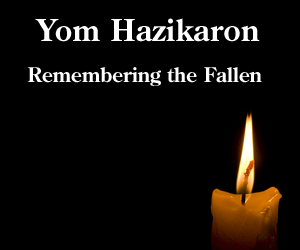
Yom Hazikarom - Remembering the Fallen
Israel marked Memorial Day on Wednesday morning as a two-minute nationwide siren sounded at 11 A.M. to commemorate the 22,993 IDF soldiers who have fallen while serving the nation.
Durch Nacht und Blut zur licht!
Saturday, 14 April 2012
American bumper stickers
Bumper stickers reveal some interesting insights of America about herself:
![]() |
| I love you America. But I think we should see other people. |
![]() |
| Be nice to America, or we'll bring democracy to your country (seen o a car with Marine corps license plates) |
Tuesday, 6 March 2012
US Attorney general on assassinations: due process is not necessarily judicial process
![]() |
| US Attorney General Eric Holder and the Drone - Imminent Threat - cartoon by John Cole |
The U.S. boldly claims and "explains" that extrajudicial assassinations are legal!
Words of Eric Holder, the Attorney General of the U.S., selected by president Barak Hussein Obama:
In his speech at at Northwestern University, Chicago, Mr Holder elaborated on the question of when the US could exert its "inherent right of national self-defense" by assassinating individuals."Some have argued that the President is required to get permission from a federal court before taking action against a United States citizen who is a senior operational leader of al Qaeda or associated forces. This is simply not accurate. “Due process” and “judicial process” are not one and the same, particularly when it comes to national security. The Constitution guarantees due process, not judicial process."
Under international law, an "imminent threat" represents the earliest point at which a country has the right to use such force.
Again in Holder's words:
So let America not complain like a spoiled child if Russia kills a Chechen in Denmark, Russia terminates an Uighur in Pakistan..."The evaluation of whether an individual presents an 'imminent threat' incorporates considerations of the relevant window of opportunity to act, the possible harm that missing the window would cause to civilians, and the likelihood of heading off future disastrous attacks against the United States."
... or if their own people are at the receiving end of such "justice"!
What about an Iranian drone popping a few people preparing an "imminent threat" in Arlington, VA, still kosher?
Arguably Mr Holder is building a case to make himself, his boss and his buddies legitimate targets!
![]() |
| Drone over the Pentagon: a simple vice-versa on the Attorney General's logic and the entire US administration are legit targets! |
Thursday, 1 March 2012
Economics researchers find a miracle cure for Southern Europe's Sovereign Debt Crisis
Without the option of a currency devaluation, there are simple fiscal alternatives to exchange-rate devaluation that can address southern Europe’s short-term competitiveness problems - this is the argument put forward by Gita Gopinath, Emmanuel Farhi and Oleg Itskhoki.
These economists, although from traditionally 'saltwater schools' stay clear of the routine arguments for stimulus or for austerity, instead they defend that:
It sounds that this way you can actually cook Huevos rotos without breaking the eggs. At first glance this theory seems to hold water only partly, as it would require massive cuts in payroll taxes to make export costs before VAT fall. A sector analysis will easily identify the possible areas of benefit. Nevertheless it looks obvious that service companies are the ones with the highest potential cost reductions... and errrr.... these in general sell to the domestic market, so any benefits here would be indirect, being eventually harvested downstream in the production chain.
These economists, although from traditionally 'saltwater schools' stay clear of the routine arguments for stimulus or for austerity, instead they defend that:
"There is a remarkably simple alternative that does not require southern Europe’s troubled economies to abandon the euro and devalue their exchange rates. It involves increasing the value-added tax while cutting payroll taxes. Our recent research demonstrates that such a “fiscal devaluation” has very similar effects on the economy in terms of its impact on GDP, consumption, employment, and inflation.
A currency devaluation works by making imports more costly and exports cheaper. A VAT/payroll-tax swap would do exactly the same thing. An increase in VAT raises the price of imported goods, as foreign firms face a higher tax. To ensure that domestic firms do not have an incentive to raise prices, an increase in VAT needs to be accompanied by a cut in payroll taxes.
Moreover, since exports are exempt from VAT, the price of domestic exports will fall. The desired competitiveness effects of exchange-rate devaluation can thus be had while staying in the euro."Should Greece, Portugal, Italy and Spain hire the Harvard / Princeton academics and dump the "Troika"?
It sounds that this way you can actually cook Huevos rotos without breaking the eggs. At first glance this theory seems to hold water only partly, as it would require massive cuts in payroll taxes to make export costs before VAT fall. A sector analysis will easily identify the possible areas of benefit. Nevertheless it looks obvious that service companies are the ones with the highest potential cost reductions... and errrr.... these in general sell to the domestic market, so any benefits here would be indirect, being eventually harvested downstream in the production chain.
![]() |
| German Euro vs South European Euros - some Euros are more equal than others... can a fiscal devaluation bring competitiveness to Southern Europe while keeping the Euro-zone intact? |
Labels:
competitiveness,
crisis,
Debt,
economics,
employment,
Europe,
fiscal devaluation,
GDP,
gipsis,
Gita Gopinath,
Greece,
Harvard,
macro,
macroeconomics,
payroll taxes,
pigs,
portugal,
Princeton,
south,
VAT
Thursday, 26 January 2012
More European!
"Do we dare to be more European?"
Chancellor Angela Merkel, World Economic Forum, Davos, Jan 25th 2011
Labels:
Angela Merkel,
Davos,
Europe,
European,
World Economic Forum
Wednesday, 25 January 2012
Portuguese Public TV licks the boots of corrupt and blood stained Angolan kleptocrats
![]() |
| Fatima Campos Ferreira and some Angolan "rich clowns" in leopard chairs - Portuguese Public TV (RTP 1) live from Luanda - Sana Hotel |
Pedro Rosa Mendes' chronicle about about a Portuguese public TV (RTP 1) show licking the boots of the corrupt and blood stained Angolan kleptocrats cost him his job with the same company.
The show illustrates how Angolan low-lives are willing to do anything to buy respectability, and worst, how the current Portuguese business pack and politicians are willing to abdicate dignity.
Shame on them all, the dignity of a proud European Colonial nation cannot be given up by such worms!
The full text is included below (first in Portuguese, the Google translation is included after the original).
“Em directo de Luanda, a RTP serviu nesta segunda-feira aos portugueses e ao mundo – eu vi aqui em Paris – uma emissão a que chamou ‘Reencontro’ e na qual desfilaram, durante duas horas, responsáveis políticos, empresários e comentadores de Portugal e de Angola, entre alguns palhaços ricos e figuras grotescas do folclore local.
O serviço público de televisão tem estômago para muito, alguns dirão para tudo, mas o Reencontro a que assistimos desta vez foi um dos mais nauseantes e grosseiros exercícios de propaganda e mistificação a que alguma vez assisti. Há até propaganda comestível, quando feita com inteligência, mas nem sequer essa bitola foi conseguida, foi permitida, à emissão. A nossa televisão, a televisão paga por todos e que, de certo modo, é um pouco de cada um de nós, afectiva mas também politicamente, foi a Luanda socializar com os apparatchik do regime, nos quais deveríamos reencontrar uma Angola irmã, uma Angola feliz, uma Angola nova.
Aconteceu o contrário. Reencontrei nesta emissão a falta de vergonha de uma elite que sabe o poder que tem e o exibe em cada palavra que diz. Não no conteúdo, mas no tom, seguro, simpático, veladamente sobranceiro. Aquela gente – as divas, os engravatados, os socialites – são. ao mesmo tempo, a couraça e as lantejoulas de uma clique produzida pela história recente de um país que combinou uma guerra de 30 anos e uma riqueza concentrada, basicamente, no petróleo.
Oleocracia, chamou-lhe a socióloga francesa Christine Messiant, falecida faz agora anos, e que identificou como ninguém a natureza do poder de José Eduardo dos Santos, do MPLA, da Grande Família e das suas clientelas. Em poucas linhas, a clique angolana, em torno do Presidente, privatizou o Estado, numa teia de clientes da ‘economia política’ angolana e num aparelho que controla, por um lado, a segurança e o uso da força, e, por outro, as contas vitais da República, como a do petróleo, dos diamantes, do Banco Nacional e do Tesouro.
Os generais e barões da economia política fizeram ganhos astronómicos nas comissões dos contratos de armamento, do petróleo, da manutenção militar, por aí fora, e depois usaram esses recursos em todos os negócios sensíveis, estratrégicos – as empresas de segurança, as companhias de aviação, os sectores das empresas públicas colocados em leasing, as companhias ligadas às forças armadas e à polícia. Um lucro incalculável e, o melhor, legal!
Como bem explicou Christine Messiant, o controlo da economia pelo topo do poder político (juntando as altas patentes e o politburo informal do Partido) usou e geriu a concorrência internacional, beneficiando a conivência, a colaboração ou a assistência de grupos estrangeiros na banca, no sector energético.
É esta, resumindo, a face verdadeira da nova Angola: o novo poder económico é apenas a nova máscara do velho poder político. Uma maquilhagem sofisticada mas óbvia, o bâton da ditadura, parafraseando o grande jornalista Rafael Marques.
Num reencontro digno para ambos os povos e ambas as audiências, teria havido por exemplo Rafael Marques, ou alguém que chamasse à corrupção, corrupção, e não, quase a medo, numa única pergunta, ‘um certo tipo de corrupção’, como fez Fátima Campos Ferreira.
Quem se encontra com a realidade de Angola, encontra a violência brutal nas Lundas diamantíferas, os despojos da guerra civil no tecido social e produtivo, a conflitualidade social latente entre quem tem o mundo e quem não é sequer dono da sua vida, ou a pobreza dos musseques de Luanda, que não desaparecem com o cair do cetim vermelho de um banco como na publicidade que embrulhou a emissão da RTP. Já agora, gostaria de ter reencontrado outros portugueses: os milhares que vão para Angola em fuga de um país sem esperança, o nosso, como se ia nos anos 50, e, como então, enfiados como semi-escravos e semi-reféns à mercê dos seus patrões – agora angolanos – num estaleiro, numa pedreira ou numa fazenda algures fora do alcance das visitas oficiais que chegam a Luanda.
Nesta emissão, enfim, Portugal confirmou que, como antes os nossos colonos, apenas temos a subserviência quando a situação não nos permite o abuso. É no que estamos. ‘Qual o objectivo do investimento angolano no estrangeiro?’, perguntava a jornalista. A resposta foi dada pela própria emissão: respeitabilidade. Luanda apenas compra aquilo que sabe que não tem.”
Pedro Rosa Mendes
English version, using Google translation (may be a bit crude!):
Public service television has the stomach for a lot, some will say to all, but the Reunion we saw this time was one of the most gross and nauseating propaganda exercises and mystification that has ever seen. There's even edible advertising, when done with intelligence, but even that gauge was achieved, was allowed to issue. Our television, pay television and for all that, somehow, is a bit of each one of us, emotional but also politically, was socializing with the Luanda regime apparatchik, in which we rediscover a sister Angola, Angola a happy, a new Angola.
The opposite happened. I rediscovered in this show the shamelessness of an elite that knows the power it has and displays it in every word it says. Not in content but in tone, safe, friendly, overlooking covertly. Those people - the divas, the suits, socialites - are. at the same time, the breastplate and spangles click produced by a recent history of a country that has combined a 30-year war and a wealth concentrated primarily in the oil.
Oilcracy, called it the French sociologist Christine Messiant, who died years ago now, and that anyone identified as the nature of the power of Jose Eduardo dos Santos, the MPLA, the Great Family and their clienteles. In a few lines, click the Angolan around the President, privatized the state, in a web of clients 'political economy' in Angola and an apparatus that controls the one hand, security and use of force, and secondly, the critical accounts of the Republic, such as oil, diamonds, the National Bank and the Treasury.
The generals and barons of political economy made astronomical gains in commissions from arms deals, oil, maintenance of military out there, and then used these resources in all business sensitive estratrégicos - security companies, the airlines the sectors of public enterprises placed in leasing, companies linked to the armed forces and police. An untold amount of profit and, above all, legal!
As well explained Christine Messiant, control of the economy at the top of political power (and joining the upper echelons and the Party's informal Politburo ) used and managed the international competition, benefiting collusion, collaboration or assistance from foreign banking groups in the sector energy.
This, in short, the true face of the new Angola: the new economic power is just another mask of the old political power. A sophisticated but obvious makeup, the lipstick of the dictatorship, to paraphrase the great journalist Rafael Marques.
A reunion worthy of both peoples and both audiences, there would have been for example Rafael Marques, or someone to call corruption, corruption, and not, almost fear, a single question, 'a certain kind of corruption', as did Fatima Campos Ferreira.
Who meets the reality of Angola, meets the brutal violence in the Lunda diamond, the spoils of the civil war in the social and productive fabric, the latent social conflict between those who have the world and who is not even master of his life, or poverty the slums of Luanda, which do not disappear with the fall of a bank of red satin and wrapped in advertising that the issuance of the RTP. By the way, I have rediscovered other Portuguese: the thousands who go to Angola on the run from a country without hope, ours, as people would go in the 1950s, and since then, stuck as semi-slaves and semi-hostages at the mercy of their employers - now Angola - a construction site, a quarry or on a farm somewhere out of reach of official visitors arriving in Luanda.
In this show, finally, Portugal has confirmed that, as our colonists before, we have only subservience when the situation does not allow the abuse. It's what we are. 'What is the purpose of the Angolan investment abroad?', Asked the journalist. The answer was given by the very issue: respectability. Luanda just buys what it knows it does not have. "
Pedro Rosa Mendes
About Pedro Rosa Mendes:
![]() |
| Pedro Rosa Mendes - Portuguese journalist |
As a reporter he covered conflicts in Angola, Rwanda, Zaire/DRC, Western Sahara, Guinea-Bissau, Sierra Leone, Liberia, the Ivory Coast, Afghanistan and the former Yugoslavia, winning Portugal’s Bordalo Prize for Print Journalism in 2000.
Between 2007 and 2009 he was posted in East Timor as Dili correspondent for the Agência Lusa de Notícias (the official news agency of Portugal), before becoming the agency’s correspondent in Paris, where he currently lives.
Mendes’s works of fiction include Baía dos Tigres (Bay of Tigers: A Journey Through War-torn Angola), which won the PEN Club Fiction prize; Atlântico (Atlantic); and Lenin Oil, which was a collaboration with illustrator Alain Corbel. His books of reportage include Ilhas de Fogo (Islands of Fire), Madre Cacau–Timor (Mother Cacau–Timor), and Schwarz Licht, Passagen durch Westafrika (Black Light–Journey through Western Africa) with photographs by Wolf Böwig.
Monday, 23 January 2012
Debt: Portugal's Minsky Moment?
![]() |
| PORTUGUESE GOVERNMENT BONDS 10YR NOTE PORTUGAL PL (GSPT10YR:IND) - graph source: Bloomberg |
The country's 10-year yields are now close to 15%. Reuters notes that Five-year credit default swap prices implied the market was pricing in a 66.8% chance of default.
In the Euro crisis time frame, Austerity and Growth seem to be at odds with each-other and the 'confidence fairy' is nowhere to be seen! As Paul Krugman said in 2010, "somehow it has become conventional wisdom that now is the time to slash spending, despite the fact that the world’s major economies remain deeply depressed". For a small, open economy of the periphery, expansionary austerity cannot be expected to work in a period when the few countries with current account surplus and a trade surplus are reducing consumption. By the time the country is globally competitive, it may be too late. In the worst scenario we could be heading for a Heinrich Brüning style deflation.
Has Portugal's Minsky Moment arrived at last?
Labels:
Austerity,
crisis,
Debt,
default,
ECB,
economics,
economist,
economy,
eu,
euro,
Europa,
Europe,
Expansionary Austerity,
growth,
keynesian,
macroeconomics,
Minsky Moment,
Paul Krugman,
portugal,
rates
Friday, 13 January 2012
Inequality in America (and Britain)
Dr. Alan Krueger, chairman of the President’s Council of Economic Advisers, spoke yesterday at the Center for American Progress about how inequality threatens both the middle class and the economy at large.
The chart below, from his Powerpoint presentation, illustrates how America became the Western World champion of Income Inequality and more surprisingly of lack of intergenerational mobility. The children of the poor stay poor. The American Dream is dead.
Furthermore, it is not a shock to see that the former colonial power, Britain, now the most American part of Europe, comes a close second to the US.
Note on the graph:
Originally from a paper by Miles Corak, professor of economics with the Graduate School of Public and International Affairs, University of Ottawa’s, it shows a negative relationship between the Gini coefficient and intergenerational earnings elasticity. ![]() |
| “The Great Gatsby Curve” - Higher income inequality associated with lower intergenerational mobility |
![]() |
| Economist Alan Krueger, Chairman of the Council of Economic Advisers and his boss, a certain Hussein Obama |
The Gini coefficient is a standard way of measuring inequality. It is an index between 0 and 1, based on the Lorenz curve, which is the proportion of the total income earned by each percent of the population. The larger the number, the less equal the society.
Intergenerational earnings elasticity is the relationship between parents’ earnings and those of their children. In a way, it shows if children can escape their parents’ poverty. According to the 1921 song by Van & Schenck, immortalized in F. Scott Fitzgerald’s "The Great Gatsby", they can’t: “The rich get richer and the poor get children.”
Therefore the title of the graph!
![]() |
| Cover of F. Scott Fitzgerald’s "The Great Gatsby" Inequality in America |
Subscribe to:
Posts (Atom)